What Is High-Velocity Oil Flushing, and Why Is It Important?

Team Minimac
Jul 30, 2025 · 7 min read


Executive Summary: Contamination Control at a Glance
| Metric / Aspect | Standard Filtration | High-Velocity Oil Flushing |
|---|---|---|
| Primary Target | Suspended particulate matter is already floating in the fluid | Bound, embedded, and sticky internal contaminants |
| Fluid Flow State | Low-velocity, steady, predictable laminar flow | High-velocity, aggressive, turbulent flow |
| Operational Window | Continuous, routine daily maintenance | Intensive, event-driven decontamination process |
| Mechanism | Simple mechanical capturing via the filter media's pore size | Kinetic scraping and stripping of internal piping walls |
The Hidden Cost of Industrial Lubricant Contamination
In every heavy industrial plant, lubrication systems share a single, uncompromising job: protect high-value machinery from wear, heat, friction, and catastrophic premature failure. Yet, an expensive reality check faces maintenance managers daily: even the absolute best lubricant cannot protect a machine if the system carrying it is contaminated from within.
Across demanding sectors like power generation, steel mills, cement plants, petrochemical facilities, and heavy engineering, internal circuit contamination stands as a top root cause of sudden equipment failure. Tiny particulate matter, welding slag, rust, varnish, sludge, and debris silently travel through fluid lines. Over time, they act like liquid sandpaper, destroying precision servo valves, scoring high-speed bearings, and chewing through hydraulic pump impellers.
The True Sources of Fluid System Contamination
Contaminants do not just leak into a system from the outside; they are often baked right into the asset lifecycle:
- Residual manufacturing debris left behind during pipeline fabrication
- Stray welding particles trapped inside complex pipe bends
- Rust and oxidation scaling form during long-term storage or transit
- Ambient moisture ingress leading to fluid degradation
- Sludge deposits and chemical varnish formation from oil aging under high heat
When these particles begin to circulate freely, they strike critical system components directly.
[System Contamination]
       │
       ├─► Bearing Scoring (Destroys metal surfaces)
       ├─► Servo Valve Sticking (Causes immediate control loss)
       ├─► Pump Cavitation & Pitting (Drops system pressure)
       └─► Accelerated Fluid Oxidation (Destroys oil additive packages)
This structural decay inevitably results in degraded hydraulic efficiency, massive energy losses, sudden valve failures, and expensive unplanned downtime. This is precisely why strategic industrial contamination control is no longer handled as a luxury but as a mandatory core pillar of modern reliability-centred maintenance (RCM).
What is High-Velocity Oil Flushing (HVF)?
High-velocity oil flushing is an advanced engineering cleaning procedure that pumps oil through a lubrication or hydraulic circuit at exceptionally high flow rates to induce temporary, controlled fluid turbulence inside the pipelines.
Unlike standard operational fluid circulation, which is intentionally smooth and slow to prevent aeration, high-velocity flushing generates significant kinetic energy. This energy effectively forces loose embedded scales and debris out of pipe walls, system reservoirs, cooling jackets, and valve blocks.
The Physics of High-Velocity Flushing
To successfully strip contaminants away, the flushing fluid must completely break out of a smooth, layered path and transition into a chaotic, mixing state. In fluid mechanics, this transition is calculated using the Reynolds number (Re).
The mathematical breakdown of this threshold is expressed as:
Where:
- p represents the density of the flushing fluid
- V represents the mean velocity of the fluid flow
- D represents the internal diameter of the pipeline
- U represents the dynamic viscosity of the fluid
To achieve the necessary turbulent flow required to actively clean internal pipe walls, the flushing setup must force a high velocity sufficient to drive the calculation to a specific threshold:
The Cleaning Threshold: A fluid system must achieve a value where Re > 4000 to ensure fully developed turbulence. Any value less than 2300 results in standard, smooth laminar flow, which leaves internal pipe debris completely undisturbed.
How an Engineering HVF Protocol Works
Executing a high-velocity flush is an intensive, rigorous procedural setup that bypasses sensitive components to protect them while clearing out the heavy pipeline architecture.
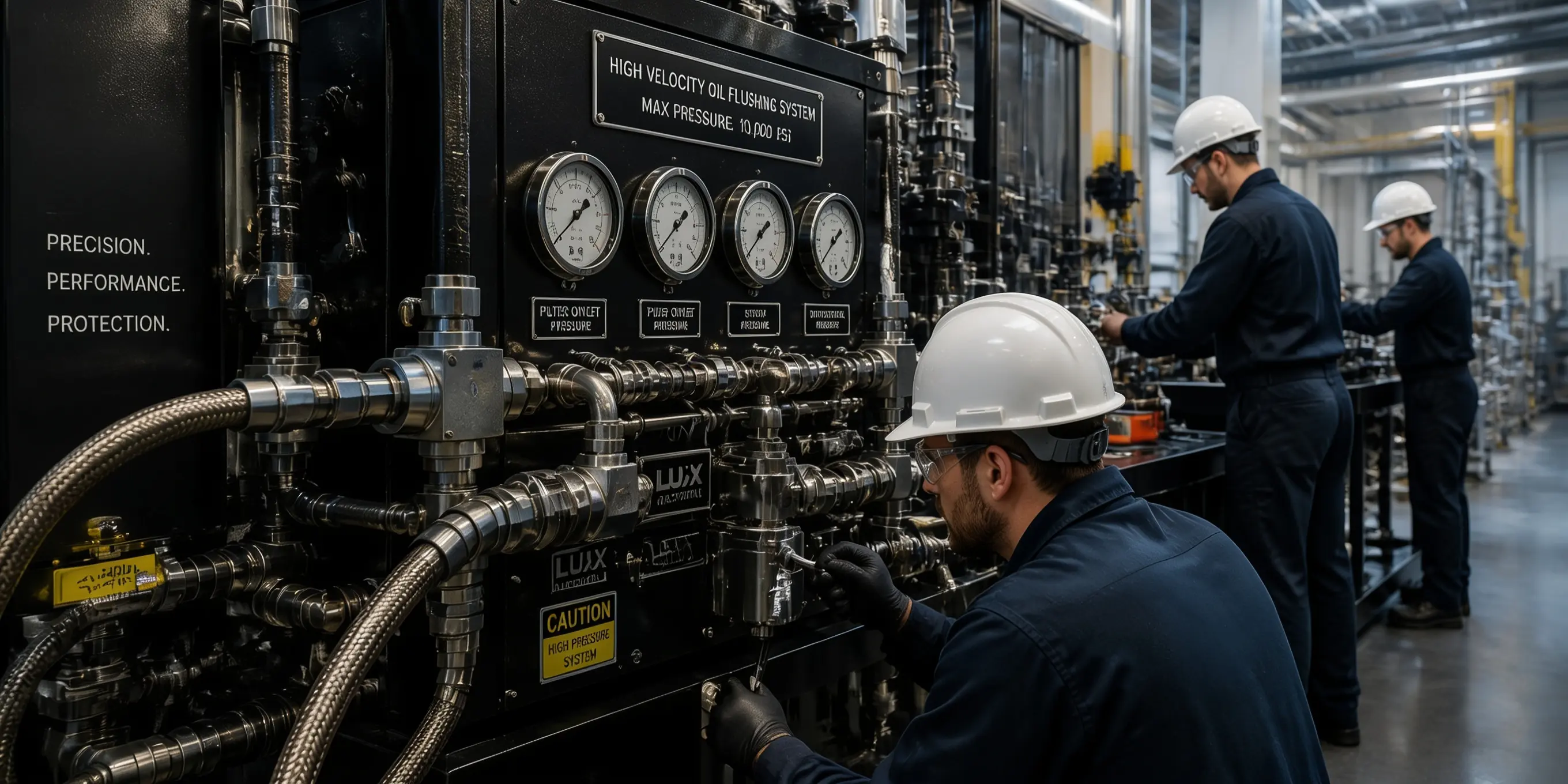
The High-Velocity Oil Flushing Setup
- System Isolation and Loop Construction: Phase 1: Mechanical Isolation. Isolate highly sensitive machinery components, such as bearing housings and precision servo valves, using custom jumper hoses and temporary piping manifolds. This creates a secure, continuous closed-loop circuit bypassing critical wear components.
- Thermal Activation and Viscosity Tuning: Phase 2: Temperature Control. Connect specialized industrial flushing skids equipped with large heating arrays. Raise the temperature of the flushing fluid to drop its dynamic viscosity. According to our Reynolds equation, lowering viscosity makes it much easier to achieve aggressive internal turbulence.
- High-Velocity Turbulent Cycling: Phase 3: High-Flow Decontamination. Engage high-capacity circulation pumps (frequently running between 30 and 330 cubic metres per hour) to drive the fluid way past its operational flow velocities, aggressively shearing away embedded pipe scales, varnish residues, and metal slag.
- Precision Multi-Stage Filtration: Phase 4: Particulate Capture. Route the turbulent, debris-laden fluid out of the pipeline loops and straight through advanced dual-stage mechanical filtration skids. These skids leverage absolute-rated pleated fibreglass filters to capture microscopic particles down to 3 microns.
- Real-Time Analysis and Certification: Phase 5: Cleanliness Verification. Utilise calibrated online particle counters to monitor the fluid system in real time. Continuous oil analysis checks progress until the system officially hits strict target international standards, such as ISO 4406 or NAS 1638 codes.
Critical Cleanliness Standards and Field Applications
Modern heavy industrial equipment relies on tight manufacturing tolerances. Microscopic particles that are completely invisible to the human eye can easily bridge the micro-gap between moving parts, leading to immediate mechanical abrasion.
- Visible to the human eye: ~40 Microns
- Oil Film Clearance in Bearings: ~1 to 5 Microns
- Target Filtration Level: 3 Microns (Captures the hidden danger)
Reliability teams universally monitor oil conditioning using strict international metrics:
- ISO 4406 Cleanliness Codes: Measures particle counts at three critical sizes: >4um, >6 um, and 14 um.
- NAS 1638 Standards: Classifies fluid contamination levels based on distinct weight classes of particle sizes across static fluid volumes.
Primary Industrial Applications
Minimac Systems' high-velocity flushing provides critical protection during several major milestones: new equipment commissioning (clearing out construction debris), routine turnaround maintenance shutdowns, major system overhauls, and directly following a severe component failure incident to catch stray wear fragments.
The technology is deployed across highly sensitive operating environments:
- Power Generation Facilities: Protecting high-speed steam and gas turbine bearing pads and hydrodynamic control lines.
- Integrated Steel Mills: Keeping heavy rolling mill automatic gauge control (AGC) hydraulic lines clean.
- Cement Processing Plants: Maintaining reliability for heavy gearboxes and large crushing units running in highly dusty environments.
- Petrochemical and Refining Complexes: Securing multi-stage centrifugal compressor systems and high-speed rotating shafts.
Business Value: The Return on Reliability
Investing in a dedicated high-velocity oil flush provides clear financial and operational advantages across five distinct categories:
1. Maximized Asset Reliability
By removing the abrasive particles that score metal and bind valves, plants experience a dramatic drop in unexpected component breakages, avoiding sudden emergency failures.
2. Doubled Lubricant Lifespan
Solid particulate contamination acts as a powerful catalyst for premature oil ageing and chemical oxidation. Removing these elements early preserves the oil's additive packages, keeping the fluid stable for much longer intervals.
3. Slashed Total Maintenance Expenses
Keeping internal plumbing pristine means components experience significantly less wear. This directly reduces annual spare parts consumption, saves specialized maintenance labour hours, and cuts out severe downtime losses.
4. Enhanced Plant Energy Efficiency
Clean fluid lines lower flow resistance and eliminate parasitic friction. Pumps do not have to work as hard to maintain target pressures, leading to optimized power draw and better heat transfer across system coolers.
5. Lower Early-Life Failure Risk
New systems are notoriously vulnerable to built-in debris left behind from assembly. A comprehensive pre-commissioning flush ensures that heavy assets start their operational life under immaculate conditions.
Conclusion
As heavy industries transition toward high-efficiency automated machinery, having a structured contamination management programme is non-negotiable.
Minimac Systems delivers field-proven, modern lubrication reliability engineering. Built with heavy-duty stainless steel (SS 304) construction to eliminate structural rust risks, Minimac's engineering systems offer dual-stage mechanical filtration capable of removing up to 99.98% of solid impurities.
Furthermore, Minimac's equipment proudly carries the prestigious GreenPro Certification, an eco-label accredited by the Global Ecolabelling Network. This ensures your plant achieves superior mechanical reliability while driving down oil waste, supporting both your profitability goals and modern corporate ESG metrics.
Learn more about our solutions and connect with Minimac Systems on LinkedIn.
Author:
"This article was written by an experienced industrial reliability and lubrication specialist at Minimac Systems, with extensive practical expertise in high-velocity oil flushing, hydraulic flushing systems, industrial contamination control, lubrication reliability, and predictive maintenance solutions. Drawing from real-world applications across power generation, steel, cement, petrochemical, marine, manufacturing, and heavy engineering industries, the content is designed to help maintenance professionals, plant managers, and reliability teams improve equipment performance, reduce downtime, extend machinery life, and enhance operational efficiency through advanced oil flushing and contamination control practices."
FAQs
Share this on
 Email
us
Email
us