Transformer Oil Filtration vs Oil Replacement: Which Is Better?

Team Minimac
Jul 30, 2025 · 6 min read


Which Method Best Maximizes Your Transformer's Dielectric Strength?
For over 85% of industrial maintenance scenarios, transformer oil filtration is the superior operational choice. While complete oil replacement immediately refreshes the fluid, it incurs massive oil procurement costs, hazardous waste disposal liabilities, and extensive facility downtime. Utilizing an advanced vacuum transformer oil purification system removes dissolved moisture, corrosive gases, and carbon silt at 70% lower capital expenditure, completely restoring the oil's dielectric breakdown voltage (up to 60 kV) and extending asset lifespans by decades.
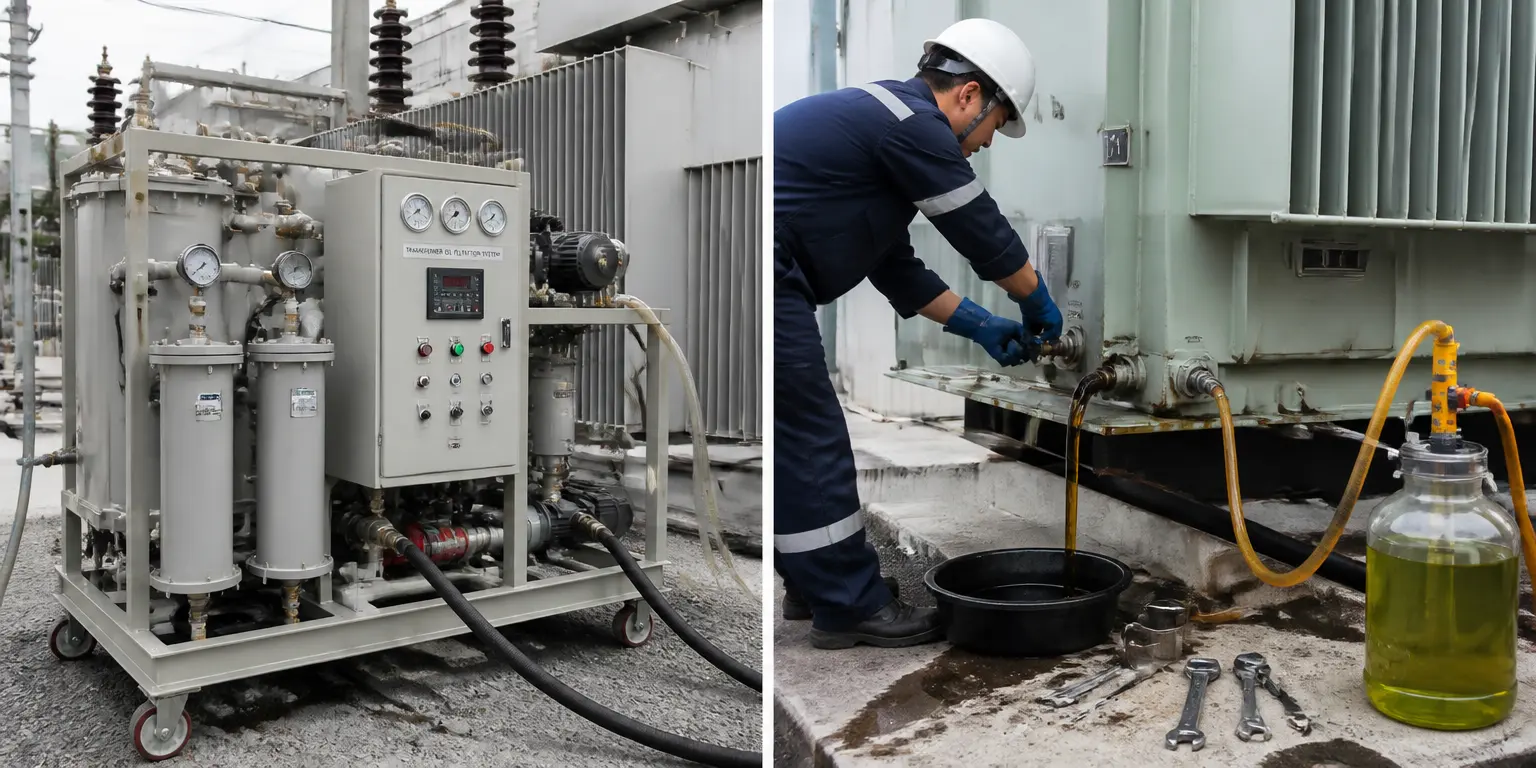
The Invisible Threat to High-Voltage Grid Assets
In every power plant, manufacturing facility, utility substation, or heavy industrial electrical network, transformers serve as the foundational backbone, ensuring continuous, high-voltage operations. Yet, one of the most critical threats to substation asset management is completely hidden from view: the physical and chemical degradation of the transformer insulation oil.
Over years of continuous thermal cycles, transformer fluid is subjected to ongoing atmospheric moisture ingress, ambient oxygen exposure, and electrical arcing stresses. This environment causes the fluid to accumulate dissolved water, microscopic carbon tracking particles, volatile gases, and acidic sludge deposits. As contamination levels rise, the fluid's critical dielectric strength drops significantly, leading to diminished cooling efficiency, accelerated decay of paper insulation, and a high risk of unexpected catastrophic failures.
[Moisture/Oxygen Ingress] ──> Acidic Breakdown ──> Sludge Accumulation ──> Insulation Decay ──> Catastrophic Arc Failure
When oil testing indicates degraded fluid parameters, asset reliability managers face a vital decision: should the transformer undergo a complete, expensive oil replacement, or can the current oil volume be completely reconditioned using a specialised transformer oil filtration machine or multi-stage transformer oil purification system?
In modern industrial asset management, advanced fluid purification has moved past being an alternative maintenance choice, it is now the standard for reliability-centred maintenance programmes.
Technical Comparison: Reconditioning vs. Replacement
To understand why industrial facilities are moving away from routine fluid dumping, it is important to analyze how both methodologies perform across key operational and economic parameters:
| Operational Metric | Vacuum Transformer Oil Filtration | Complete Insulating Oil Replacement |
|---|---|---|
| Capital & Material Cost | Extremely Low; typical savings of 60% to 75% compared to purchasing fresh oil. | Extremely High; requires substantial capital for bulk oil procurement. |
| Downtime Requirement | Minimal; can often be performed onsite, with advanced units supporting online execution. | Severe; requires total system shutdown, deep draining, flushing, and refilling. |
| Moisture & Gas Removal | Excellent; extracts free, emulsified, and dissolved water under 100 ppm via deep vacuum. | Moderate; new oil still requires processing to remove moisture absorbed during shipping. |
| Environmental & ESG Impact | Elite; supports zero-waste circular economy initiatives and lowers carbon footprints. | Poor; generates large hazardous waste volumes and introduces transport liability risks. |
| Sludge & Particle Extraction | Cleans both suspended fluid debris and loose internal core contaminants through recirculation. | Flushes loose debris but can leave heavy sludge layers stuck to the internal paper insulation winding. |
Deconstructing the Engineering Processes
To choose the proper approach for your substation infrastructure, it helps to understand the underlying mechanics of how both maintenance methods handle fluid purification:
1. The Mechanics of a High-Vacuum Transformer Oil Purification System
A modern transformer oil filtration machine does not just pass fluid through a standard physical screen. It uses a multi-stage thermal and vacuum conditioning loop to systematically restore the fluid's molecular chemistry:
[Deteriorated Oil] ──> Inline Heat Exchanger (60°C) ──> Particulate Microfiltration ──> Vacuum Degassing Chamber ──> Restored Dielectric Oil
- Thermal Conditioning: The oil passes through low-watt-density heaters, rising to roughly 60°C. Heating reduces fluid surface tension, accelerating the separation of trapped water molecules and gases from the oil molecules.
- Absolute Micro-Filtration: The heated fluid passes through absolute-rated fibreglass filter media, removing microscopic carbon particles, rust scales, and metallic wear debris.
- Vacuum Dehydration & Degassing: The oil enters a high-vacuum chamber where a deep negative pressure (often less than 1-5 mbar) causes dissolved water and dangerous combustible gases (like acetylene, hydrogen, and methane) to flash evaporate out of the fluid. The purified fluid is then pumped back into the transformer tank, completely clean and dry.
2. The Realities of a Complete Oil-Replacement Program
Oil replacement is a complex chemical transfer process. It requires taking the transformer completely offline, isolating high-voltage connections, draining thousands of litres of hot dielectric fluid, and shipping it away as hazardous waste.
Once drained, technicians must flush the internal core assembly to remove heavy sludge stuck to the paper insulation layers. New oil is then pumped in under a vacuum to prevent air pockets from forming within the windings. Despite using brand-new fluid, the processed oil often requires a final run through a vacuum oil purifier to eliminate moisture absorbed from the air during shipping and handling before recommissioning can begin.
Why Modern Plants Prioritize In-Situ Oil Filtration
1. Significant Financial Reductions
Dielectric insulating oil is a specialized commodity subject to global supply fluctuations. For massive power transformers holding tens of thousands of litres of oil, total replacement costs can severely strain annual operational budgets. Utilizing an advanced vacuum oil purifier allows facilities to completely restore existing oil parameters, eliminating the need for bulk oil purchases and hazardous waste disposal fees.
2. Advanced Mitigation of Maintenance Downtime
Executing a full oil change requires an extended facility shutdown, which can disrupt power distribution and freeze production lines. Modern transformer oil purification systems from industry leaders like Minimac Systems are designed for highly efficient, automated onsite mobilisation. These systems can process the oil through a continuous bypass loop and, under controlled conditions, can even perform online filtration while the transformer remains completely energised and operational.
3. Fulfilling Corporate ESG & Circular Economy Goals
Dumping thousands of gallons of recyclable industrial oil runs directly counter to modern corporate sustainability goals and Environmental, Social, and Governance (ESG) compliance directives. Transformer oil filtration supports a true circular economy strategy by reclaiming and reconditioning existing resources indefinitely. This approach drastically lowers a facility's scope 3 carbon footprint, reduces hazardous waste risks, and supports international environmental compliance standards.
When Total Oil Replacement is Required:
While advanced purification systems are highly effective, there are specific situations where the fluid's underlying chemical matrix has degraded past the point of mechanical restoration. Replacement becomes necessary when diagnostic testing reveals:
- Severe Total Acid Number (TAN) Escalation: When acidity rises above 0.3 mg KOH/g, the oil undergoes irreversible chemical breakdown, creating corrosive compounds that attack the internal paper insulation.
- Extensive Varnish and Solid Polymer Polymerisation: If the oil turns into a dark, burnt jelly state, it can completely block internal cooling ducts.
- Severe Asset Internal Failure Contamination: Large internal electrical faults can vaporise components, filling the oil with heavy soot, melted copper, and structural carbon debris.
To reliably determine the proper course of action, maintenance teams must utilise transformer diagnostic equipment and routine Dissolved Gas Analysis (DGA) testing. These diagnostic tools identify exactly when a fluid can be saved by filtration or when it requires a complete replacement.
[Fluid Breakdown Alert] ──> Run DGA & TAN Tests ──> If Acid/Sludge is Extreme ──> Execute Replacement
                                                └──> If Moisture/Gas is Dominant ──> Deploy High-Vacuum Filtration
Conclusion: Driving Asset Longevity with Smarter Maintenance
In modern power management, managing transformer oil condition purely through reactive oil dumping is an outdated and expensive strategy. Except in extreme cases of advanced chemical oxidation, utilizing a high-performance transformer oil filtration machine or specialized vacuum oil purifier delivers a smarter, more cost-effective, and highly sustainable maintenance pathway.
Investing in proactive, continuous oil contamination control keeps your insulation fluid consistently above target dielectric limits. This approach protects your facility's high-value infrastructure assets, eliminates unplanned outages, and optimizes long-term plant performance.
Learn more about our solutions and connect with Minimac Systems on LinkedIn.
About the Author
This article was written by a transformer maintenance and oil purification expert at Minimac Systems. The author brings deep industry experience in transformer oil filtration, vacuum oil purification systems, dielectric oil management, and industrial asset reliability. Drawing from practical field applications in power plants, utilities, and heavy industrial operations, the content focuses on helping industries improve transformer performance, reduce downtime, and support sustainable maintenance practices.
FAQs
Share this on
 Email
us
Email
us