Oil Filtration vs Oil Flushing: What’s the Difference, and When Do You Need Both?

Team Minimac
Jul 13, 2026 · 8 min read


What Is the Difference Between Oil Filtration and Oil Flushing, and When Do You Need Both?
The Fast Answer: Oil filtration continuously removes contaminants from operating lubricants, while oil flushing is an intensive cleaning process that removes accumulated debris from an entire hydraulic or lubrication system before startup or after maintenance. Together, they form the foundation of contamination control in hydraulic systems, helping reduce equipment failures by up to 80%, extend component life, and maintain ISO 4406 cleanliness targets.
Why Contamination Remains the Biggest Threat to Hydraulic Reliability
Hydraulic and lubrication systems are designed to operate with precise clearances, controlled fluid flow, and clean lubricants. Yet contamination continues to be one of the leading causes of equipment failure across industries.
The failure pathway often looks like this:
[Contamination Entry] ──> [Particle Circulation] ──> [Component Wear] ──> [Performance Loss] ──> [System Damage] ──> [Downtime]
Industry research consistently indicates that 70% to 80% of hydraulic and lubrication failures are contamination-related. These failures rarely happen overnight. Instead, microscopic particles gradually damage pumps, valves, bearings, actuators, and critical surfaces until performance deteriorates.
Based on extensive field experience, Minimac Systems has observed that many organizations invest heavily in equipment upgrades while overlooking one of the most cost-effective reliability improvements available—effective contamination control.
This is where oil filtration and oil flushing become essential.
Although often confused, they serve very different purposes and should be viewed as complementary reliability practices rather than interchangeable solutions.
Understanding Oil Filtration and Oil Flushing
Before comparing them, it is important to understand what each process actually does.
What Is Oil Filtration?
Oil filtration is the continuous or periodic process of removing contaminants from lubricating oil or hydraulic fluid during normal equipment operation.
The primary objective is to maintain oil cleanliness by removing:
- Dust
- Wear particles
- Metal debris
- Dirt contamination
- Oxidation by-products
Most industrial oil filtration systems use filter elements rated at specific micron sizes to capture contaminants before they can damage equipment.
What Is Oil Flushing?
Oil flushing is a specialized cleaning process performed before commissioning, after maintenance, or following contamination events.
The purpose is to remove contaminants trapped throughout the system, including:
- Welding slag
- Rust particles
- Fabrication debris
- Installation contaminants
- Sludge deposits
- Construction residue
Unlike filtration, flushing focuses on cleaning the entire hydraulic circuit rather than simply maintaining fluid cleanliness.
Hydraulic oil flushing typically uses high-velocity turbulent flow combined with temporary filtration systems to dislodge and remove contaminants from piping, reservoirs, valves, and equipment.
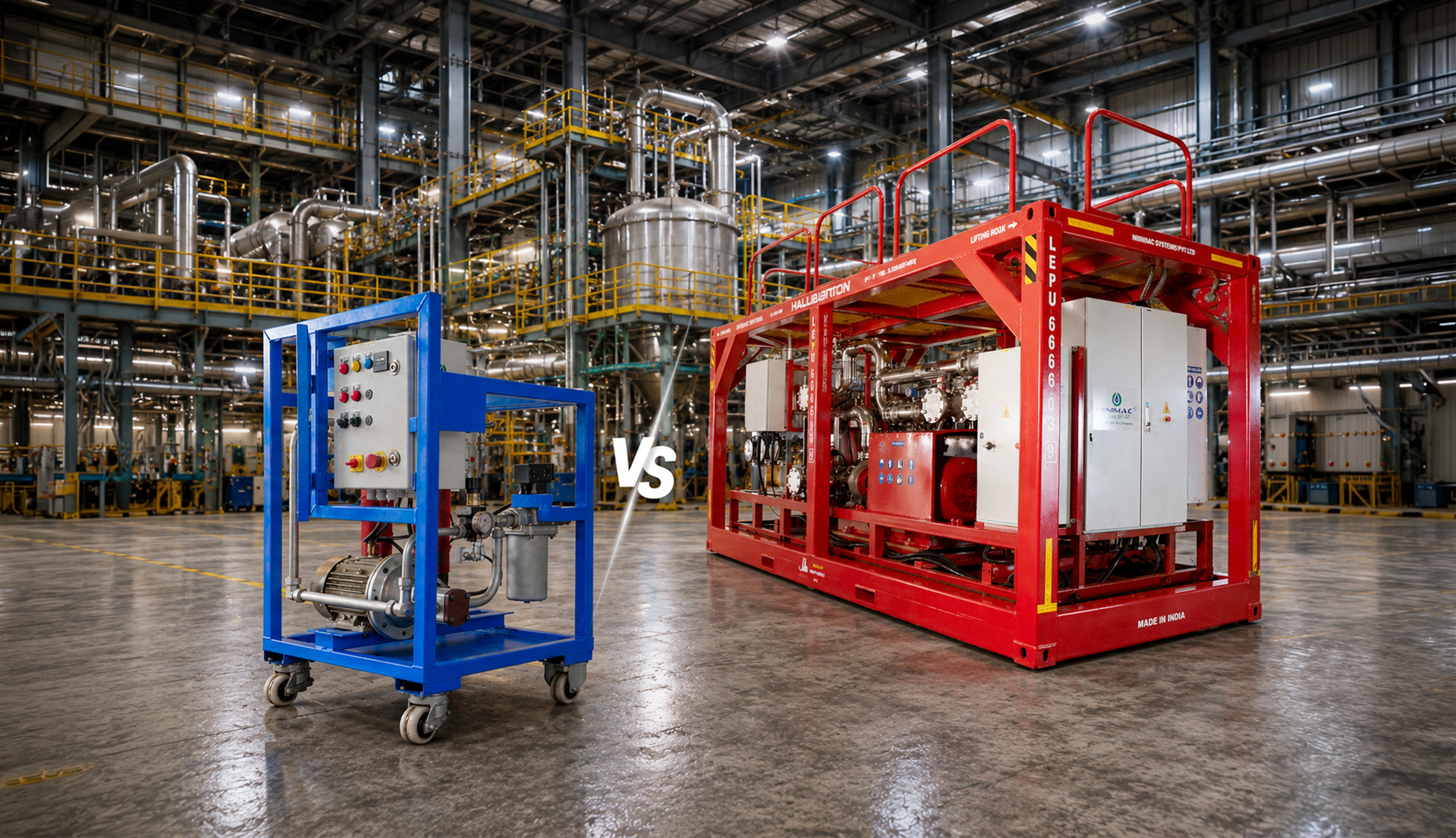
Oil Filtration vs Oil Flushing: Side-by-Side Comparison
| Factor | Oil Filtration | Oil Flushing |
|---|---|---|
| Primary Purpose | Maintain oil cleanliness | Clean the entire system |
| Timing | During operation | Before startup or after maintenance |
| Contaminants Removed | Suspended particles | Embedded and accumulated debris |
| Flow Conditions | Normal operating flow | High-velocity turbulent flow |
| Frequency | Continuous or routine | Periodic project-based activity |
| Equipment Used | Industrial oil filtration system | Dedicated flushing equipment |
| Objective | Prevent contamination buildup | Remove existing contamination |
| Impact on Reliability | Ongoing protection | System restoration |
This comparison highlights why one process cannot completely replace the other.
Why Oil Filtration Alone Is Not Enough
Many facilities assume that installing a high-quality industrial oil filtration system solves contamination problems permanently.
Unfortunately, contamination often exists in locations that normal operating flow cannot effectively clean.
Examples include:
- Pipe dead legs
- Reservoir corners
- Valve cavities
- Hydraulic manifolds
- Newly fabricated piping
Even the most efficient filtration system cannot remove contaminants that remain trapped inside the system.
This is one reason why Minimac Systems frequently recommends hydraulic oil flushing following major maintenance, equipment installation, or system modifications.
Without flushing, contaminants left behind during fabrication or repairs may circulate once the equipment starts operating.
Why Oil Flushing Alone Is Not Enough
Oil flushing is highly effective at restoring cleanliness, but it is not a permanent contamination control strategy.
Once a system returns to operation, contamination begins entering through:
- Breathers
- Seal wear
- Maintenance activities
- Environmental exposure
- Internal component wear
Without ongoing filtration, cleanliness levels will gradually deteriorate.
The contamination cycle looks like this:
[System Flushed] ──> [Normal Operation] ──> [New Contamination Entry] ──> [Particle Accumulation] ──> [Performance Degradation]
This is why organizations need both flushing and filtration.
One establishes cleanliness.
The other maintains it.
When Do You Need Hydraulic Oil Flushing?
Hydraulic oil flushing is recommended whenever contamination levels are likely to exceed acceptable cleanliness targets.
Common situations include:
New System Commissioning
New hydraulic systems frequently contain:
- Welding residue
- Pipe scale
- Rust particles
- Fabrication debris
Flushing removes these contaminants before equipment startup.
Major Equipment Overhauls
During maintenance activities, contaminants can enter the system through:
- Open hydraulic circuits
- Component replacement
- Reservoir access
- Pipe modifications
Flushing helps restore cleanliness before returning equipment to service.
Contamination Incidents
Unexpected contamination events may involve:
- Water ingress
- Component failures
- Dirt intrusion
- Filter bypass conditions
Hydraulic oil flushing can rapidly remove contamination and prevent further damage.
Critical Reliability Applications
Industries commonly requiring flushing include:
- Oil & gas
- Power generation
- Marine
- Manufacturing
- Mining
- Steel
- Cement
When Do You Need an Industrial Oil Filtration System?
An industrial oil filtration system is essential whenever equipment depends on clean lubricants for reliable operation.
Applications include:
Hydraulic Systems
Hydraulic pumps and servo valves require strict cleanliness levels to operate efficiently.
Turbine Lubrication Systems
Contaminated oil can accelerate bearing wear and reduce turbine reliability.
Gearboxes
Filtration helps remove wear particles that would otherwise accelerate gear damage.
Compressors
Clean lubricants improve efficiency and reduce maintenance costs.
Industrial Process Equipment
Continuous filtration helps maintain lubricant health and extend equipment life.
Many facilities rely on Minimac Systems industrial oil filtration system solutions to maintain ISO cleanliness levels and support long-term reliability objectives.
The Role of ISO 4406 in Contamination Control
The effectiveness of both filtration and flushing is often measured using ISO 4406 cleanliness standards.
Typical cleanliness targets include the following:
| Equipment Type | Recommended ISO 4406 Level |
|---|---|
| Servo Hydraulic Systems | 15/13/10 |
| High-Pressure Hydraulics | 16/14/11 |
| Proportional Valve Systems | 17/15/12 |
| General Hydraulic Systems | 18/16/13 |
| Mobile Equipment | 19/17/14 |
Achieving these targets requires both:
- Effective hydraulic oil flushing
- Continuous industrial oil filtration
Organizations implementing comprehensive contamination control programmes often experience dramatic improvements in equipment reliability.
How Filtration and Flushing Work Together
Rather than choosing between the two, leading reliability-focused facilities integrate both into a single contamination control strategy.
The process typically follows:
[Hydraulic Oil Flushing] ──> [ISO Cleanliness Verification] ──> [Equipment Startup] ──> [Continuous Oil Filtration] ──> [Ongoing Monitoring]
This approach provides:
- Cleaner system startup
- Reduced wear rates
- Longer lubricant life
- Improved equipment efficiency
- Lower maintenance costs
- Greater operational reliability
According to field observations from Minimac Systems, facilities implementing both flushing and filtration frequently achieve significantly lower contamination levels compared to those relying on filtration alone.
Strategic Steps for Effective Contamination Control in Hydraulic Systems
Organizations seeking world-class reliability can follow a structured contamination control strategy.
Step 1: Establish Cleanliness Targets
- Define ISO 4406 requirements
- Review OEM recommendations
- Identify critical assets
Step 2: Conduct Hydraulic Oil Flushing
- Flush new systems
- Flush after major maintenance
- Remove embedded contamination
Step 3: Install an Industrial Oil Filtration System
- Maintain cleanliness levels
- Continuously remove particles
- Extend lubricant life
Step 4: Monitor Oil Condition
- Perform particle counts
- Analyze contamination trends
- Verify cleanliness targets
Step 5: Improve Contamination Control Practices
- Upgrade breathers
- Improve storage procedures
- Standardize maintenance practices
Step 6: Build a Reliability Culture
- Train personnel
- Establish contamination control procedures
- Track cleanliness performance metrics
Conclusion
Oil filtration and oil flushing serve different but equally important roles in equipment reliability. Flushing removes contamination already present within the system, while filtration continuously prevents contamination from reaching damaging levels during operation.
Organizations that rely on only one approach often leave significant reliability improvements untapped. By integrating hydraulic oil flushing, industrial oil filtration systems, and proactive contamination control in hydraulic systems, facilities can significantly reduce failures, extend equipment life, and maintain optimal performance. Through advanced contamination control technologies and reliability engineering expertise, Minimac Systems helps industries achieve cleaner systems, healthier lubricants, and more reliable operations.
Learn more about our solutions and connect with Minimac Systems on LinkedIn.
About the Author
This article was authored by the technical experts at Minimac Systems, specialists in industrial lubrication, contamination control, oil filtration, vacuum dehydration, fluid management, and reliability engineering. Drawing on decades of industry experience, the Minimac Systems team shares practical insights, best practices, and innovative solutions that help organizations improve equipment reliability, extend asset life, reduce maintenance costs, and achieve their sustainability goals through effective lubrication management.
FAQs
Share this on
 Email
us
Email
us